Thursday, October 12, 2017

Performance & Composer's Diary

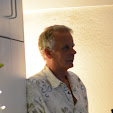
On 9/16/17 we had an afternoon of music I've composed and arranged. Jeff Poole of the Orange County Review, and a great photographer, was there in a private capacity and took these pics so unobtrusively I never noticed he was taking them. (Thanks, Jeff!)

Here's the music room with the 1923 Steinway where it all happened.
While people were gathering and getting their drinks, I played some of the piano pieces I wrote back in the late 80's and early 90's

Here's Karla, our hostess with the mostess, welcoming her guests.
The first number was Mosaic, dating from around '93 or '94, with Dr. Andy playing the lead on cello.
Then with Heather joining us on clarinet we did "Encumbrances of Angels", a poem by Dr. Andy's wife Janet I set to music sometime in the late 90's.
Here's Janet reading "My Tale", a poem of hers I set to music last year.

This pic shows Karla singing "My Tale" with Benjamin joining us on violin. 

I doubled Karla's vocal an octave down in the alto flute.

Lama Tashi was here from Arunachal Pradesh and we did the Mandala Offering and the Om Mani Peme Hung chant from Mantra Mountain, with Stephen joining us on cello.


From this pic it looks like I neglected to give Benjamin the music and he's having to look over on to Dr. Andy's music

Here's one section of the audience with top row from left to right my sister-in-law Carolyn, cousin John, his wife Kate, cousin Ada and cousin Wallace.

In this pic Heather, Andy and I are playing "explorations", a trio I wrote three or four years ago.

Here are Sage, Patrick and Benjamin playing Karlalied, which was written two years ago.

These three are all students at James Madison University and really fine players and here you can see them playing with a wonderful ensemble feel . . . 

. . .  and with marvelous expression

That feeling when you hear your music being played by others and you can just sit back and listen and hear them take it places you hadn't realized it could go.

Taking a well deserved bow

The last piece on the program was Mosaic again, but this time with Heather playing the lead and Dr. Andy playing an accompanying line I added just a few months ago

Monday, July 31, 2017

KarlaLied 1st movement

Here's an attempt at doing a video with the score and then putting on YouTube and then embedding. Been so long since the last, and there have been changes in the how to. This is the first recording of the first movement of KarlaLied.


(After posting) Well . . . seems to work OK.

Saturday, July 22, 2017

The Fun Factor

In the same conversation mentioned in this post, the importance of having fun with music came up. The music educator talked about how most, if not all, high level students and performers go into music in the first place because it's fun, but somehow along the way that can get lost. That really resonated with me because:

1) - I started the Fun Band because so much of the therapeutic value of music making can come from simply having fun doing it, especially with others. Working with easier material and exploiting what technique is already there can yield out sized therapeutic results.

2) - One problem I always had with community band was we never completely "owned" a piece - it was always "mostly" getting something and then moving on to something else and rarely, if ever, coming back and polishing it up. That's a great way to proceed if your aim is improving technique and nothing else, but I always felt interpretation and self-expression got short shrift because all of the grappling with technique left no room for that side of music making.

3) - Part of the problem brought on by recorded music is that before it came along, people could have fun making music and could only compare themselves to others making live music. Now there are always numerous examples of every piece of music recorded "to perfection", making home made music sound rough around the edges in comparison. If you're making the music yourself, though, and having fun doing so, it matters less in the moment how close it comes to error free recordings.

4) - Lack of fun can have a negative effect on the impact of very high level music making on the listener. My cello friend Dr. Andy loves the joke of someone coming up after a performance and telling the player, "I never knew how hard that piece was." Sometimes it sounds as though high level players get so caught up in the technique of it all it seems they forget there's more being a good musician than simply having killer technique.

5) If the Music Room succeeds, both players and audiences need to be first of all having fun, which can then lead to other benefits. The first step of music therapy is engaging the client, and keeping things fun has a lot to do with that.

ADDED 7/25/17 - One thing I meant to mention and forgot is that over the years I've been caught off guard several times by very high level players being the ones the most enthusiastic about my easy, but fun to play part books. I'd assumed that being able to play at a high level was something of it's own reward, and surely it is (though there are people who burn out). My guess is that playing music not full of technical challenges lets high level players fully unleash the interpretive and expressive sides of themselves that grappling with technique issues can push to the background.

Friday, July 21, 2017

Performance Diary

     Here are some pics of the Kenwood Players last month at the Art Center In Orange's 20th anniversary. We did one set of standard Dixieland and one set of big band tunes I've arranged for our small combo. The pics are especially good because 1) they were taken by Jeff Poole, who is a great photographer as well as putting out the local paper and 2) the lighting and the decorations had us feeling we were in a fishbowl, because at the first meeting to start the Art Center 20 years ago, all the donations were put into a fishbowl. 


Wednesday, June 28, 2017

Instrument Petting Zoo and Beyond

There is in the works a non-profit aimed at nurturing music making here in my hometown of Orange, Va - and once the details are more settled, there will be posts on what it is and how it will work. For now there'll be a few posts like this one thinking through various aspects of such an undertaking, and the tag for these posts will be "The Music Room".

I'd seen on the FaceBook page of the Charlottesville Municipal Band that they often have an instrument petting zoo before concerts, where members of the band let all comers, mostly children judging from the photos, try out various instruments for themselves. 

Then, in conversation with a high level music educator, he suggested something similar to that at The Music Room as a way to draw in people to the possibility of making music themselves instead of just being a listener. Hearing the idea in that context reminded me of something I often noticed back in my private practice days, that people with zero experience in making music are very often drawn to a very particular instrument and if you can work with them on that instrument, their progress and joy in music making seems amplified.

There's also the idea I came across back when researching a music program for Montpelier - that back in James Madison's day, taverns very often kept instruments on hand for patrons to use extemporaneously. 

Then that led to the idea that if there were instruments on hand, maybe some of the many people who played in high school band, and then gave it up, could play along with easy Fun Band tunes arranged as they are for beginners.

Tuesday, November 22, 2016

Rapidan Orchestra Rehearsal Photos

We had a husband and wife team of photographers come to the last rehearsal before our fall concerts to take some informal pictures, without using flashes, as that would probably have been too distracting.

Here's our new conductor Benjamin, who is just terrific. His knowledge of the music is so phenomenal he can sing anyone's part instantly, and his verbal and gestural suggestions convey the gestalt he's after, as well as the details.

Charles W., our concertmaster, like many of our members, plays in a number of other groups, one of which specializes in Russian music.

Michael, besides his musical activities, restores WWII aviation radio equipment for the Smithsonian.

Brian is recently retired from the U.S.Navy.

Carol and her husband Roger (cello) have been with us from the beginning.

Jenny recently retired from teaching and is enjoying spending more time with violin.

Kelly on viola is a Montessori teacher over in Charlottesville and her husband John plays trumpet with us.

Here's Roger (husband of Carol/violin) on cello.

Joe B. grew up over in Barboursville and recently returned when he retired and just joined us this semester.

The other Joe B. on string bass wasn't with us at this rehearsal as he had a performance with another group, so I dug out this pic from several years ago of him with a Dixieland Jazz group - he played great that day, even when given the wrong chart for a piece and just played by ear.

Karen is one of those many M.D.s that somehow finds time to make music - and has college age sons majoring in music.

Don on flute is a retired accountant, professional photographer and holds a music degree in flute performance.

Lynne, when not playing flute, is a veterinarian working on emerging infectious diseases for the CDC.

Charles T. is the volunteer director of the Orange Community Band (and the longest serving one) and an assistant conductor and first oboe in the Charlottesville Municipal Band. His playing of the oboe in orchestra rehearsals and concerts has taught me more about "musicality" in classical music than any other single thing - especially his full, rich tone and his ever alive phrasing. (His wife Theresa wasn't present when these photos were taken - she plays piano/keyboard for us, and percussion in the Orange and C'ville bands.)

Heather, a homeschool mom and former band director, was a founder of the orchestra and does more work than anyone else keeping us going - and has gorgeous tone on the clarinet.

Don plays clarinet in a number of groups, as well as recorders in my Fun Band. His duet with Heather in the Bizet was a highlight of these concerts.

John retired to this area after a star studded pro career in both the classical and jazz genres.

Pete has been a mainstay of the Orange Community Band, and I'll always be grateful to him for being such a gentleman 12 years ago when I sat next to him and was a rank beginner on the horn - he handled the sounds I was making with great aplomb.

Grace is from Charlottesville, a college student, and will be off to New Zealand soon for a year abroad.


Here's me.

Nick is the music director over in Greene County High School and plays trombone, trumpet and horn for us.

Charles H. is a local dairy farmer who finds time to play with us, as well as being in the Orange Community Band and the Charlottesville Municipal Band - his touch in the timpani rolls is wonderful.

And here's Karla, who helped found the Orange Music Society over 25 years ago, organizing house concerts of classical music, and was good enough to join our board when we were getting started. She organizes the ads in the local papers and sends out by mail something like a 100 flyers for our concerts to people she knows, as well as putting them up all around Orange and Madison.

And here's a group shot from the choir loft.

Wednesday, April 20, 2016

Small Town Classical Response

A year and a half ago, the Rapidan Orchestra came together here in Orange, and this past weekend we just had our third pair of concerts, one in the neighboring county of Madison and one here in Orange. Since I grew up here, I know a lot of people coming to the concerts, and besides speaking with some there, also see people around town in the days after and have more conversations.

I have been amazed by the response we're getting. I came very late to classical music and can't sight read at all well, but after many years being a psychiatric attendant, group therapist, and music therapist, reading the facial expressions and body language of people is second nature to me. In nearly all the conversations I've had about the Rapidan performances, people's eyes are wider than usual, and their body language is more fluid and expressive of positive emotions than usual - to a degree I find surprising and exceptional.

Two things come to mind to explain this effect we're having. One is the music itself - Beethoven, Brahms, Bizet, Fauré, Haydn, Sibelius - with a few newer (tonal) works in the mix. For some aficionados, the pieces we're doing are passé warhorses, but for a lot of our audience, it may well be the first time they've heard these pieces live, which is a totally different experience from recordings, which in this day and age are the norm. And there's a reason these pieces have stood the test of time. In a Jungian sense they must somehow express archetypes floating around in the collective unconscious. My read is that we're not just entertaining people, but that the music is touching them deeply.

The other thing is the intimate settings - usually churches - one of which has superb acoustics and very comfortable pews. We rarely have more than 100 people at the concerts, so everything is up close and personal. A lot of us musicians go out and say hello to people we know during intermission and after the performances, giving things a personalized feeling. My sense is that these small venues help the audience really feel they are a vital part of the triangle Britten talked so much about - the composer - the performer(s) - the audience; that all three are vital parts of the musical experience.

Friday, March 11, 2016

Great Neuroscience Article

This article in Nautilus pulls together things in the neuroscience of music and takes us another conceptual step toward more fully understanding the ways music affects us. 

The main idea is that music can be, and usually is, a social activity, even when you're listening alone - which is a great way to think about mirror neurons and how important they are. This is the first time I've seen someone say just listening to music, without seeing it performed, can trigger mirror neurons. Given my idea that music is in part physical gesture made audible, it's great validation.

Something else that I think is helpful is the use of "pre-cognitive" in the explanation, which may be a better term than "non-conscious", a term I've used to say the same thing.

There's also a wonderful working definition of what music is. 

Here is a long snip from the article:

Music is as much a part of human evolution as language, tool-making, and cognitive development, Schulkin and Raglan tell us. It’s a bridge. “Music is typically something shared, something social; we may sing in the shower or on a solitary walk, but music is most of the time social, communicative, expressive, and oriented toward others,” Schulkin and Raglan write.

Molnar-Szakacs explains the brain’s mirror-neuron system provides the neural basis of music’s social powers. The properties of the human mirror-neuron system are based on research showing that the same regions in our brain are active when we perform, see, or hear an action. The “mirror” regions of our brains fire whether we’re playing the guitar or listening to Pete Townshend play it.

The mirror-neuron system, Molnar-Szakacs says, “allows someone to identify with another by providing an automatic, pre-cognitive mechanism by which to understand their actions by mapping them onto our own neural representations of those actions. In addition, it represents the intention behind those actions.”

The moment you hear a sequence of hierarchically organized abstract sounds we call music, a multitude of associations are activated in your brain. These can include memories, emotions, and even motor programs for playing music. Together they can imply a sense of human agency. That sensation is what sets music apart from other types of sounds. “The brain interprets the structure of the music as intentionality that is coming from a human agent,” Molnar-Szakacs says. “This, combined with all the associations evoked by the music, is what makes the experience social.”

There's more to the article, it's all interesting, and it's all worth reading. 

Thursday, February 11, 2016

Audio Note

The photo below is from a little Mardi Gras performance in a local French restaurant. Because of space considerations, we had just four players, along with a couple of guest vocalists. On the left you can see one of the speakers, and just a bit of the other can be seen near the bottom of the wine rack on the right. The mixer is right behind me, where I could easily turn around a tweak the settings, and the mics for the guest vocalists are on top of the speaker on the left. The mic for my occasional vocals is attached to my music stand and the foam cover is just barely visible above my music books.

The main thing I want to point out is how the speakers are set up so they work at least as much as monitors for us as they do to put sound out to the audience. Since I started performing publicly about ten years ago, I've discovered a lot of people have been traumatized by overly loud sound systems, which sometimes are so loud one can't carry on a conversation, and sometimes actually hurt one's ears they're so loud.

The way they're set up here, if they're too loud, we the players will be the first to know. The sweet spot for the sound was right in front of us and a bit to the right. People siting at tables in that area said the mix was very good. I recorded the gig with the recorder up near the tin ceiling in the corner of the room back above the left shoulder of the person taking this picture. From there the vocals, the only thing amplified, are not as present in the mix. The catch is, had I turned up the sound enough for the mix to be good there, people would have had to yell to converse. So there's never a perfect solution. 

Monday, February 8, 2016

Recalibration

Thanks to Kyle Gann friending me on FaceBook, a lot of new music has come my way. I particularly like this one for two reasons. 

First, there's the marvelous slowness of it. I've always thought there was room for a lot more very slow music, and I even made a CD trying to fill that gap, but this piece is way slower than anything I can remember encountering, while not becoming boring. It has the effect on me of recalibrating my sense of time, getting me to realize I'm not as calm and relaxed as I'd like to be. While it's almost ambient, there's always the sense of meant structure (at least to me).

The other thing is that this piece recalibrates my ears. By the end of it, I feel my ears are hearing much more delicately than usual - that there's greater depth to the soft sounds than when the piece starts. It's as if my ears are relaxing along with my time sense.


Terry Jennings's 1960 piece for solo piano 'For Christine Jennings', played by John Tilbury. From the CD 'Lost Daylight', which features music for piano and electronics by Terry Jennings and John Cage. www.anothertimbre.com

Tuesday, February 2, 2016

Shamanic American Music

Since I think that music can have beneficial effects, I also have to accept it can have negative ones, and that there are probably cases where whether the effect is positive or negative depends upon one's perspective.

It's also the case that music has had its shamanic uses down through the millennia, and my feeling is it probably depends on the shaman as to its effects.

This video popped up a few days ago, and to me, it's an obvious shamanic use of music. I'd known about this event, but had no idea Jean Luc Goddard had filmed it.


Thursday, January 28, 2016

Bernstein's Young People' Concerts

Terry Teachout's newest post talks about Leonard Bernstein's television shows back in the late 50's through the early 70's that were called "Young People's Concerts". I only saw a few of them, but had the LP of the one he did on the first movement of Beethoven's Fifth Symphony, which I listened to over and over. He went through the sketch books and found earlier versions of what we now hear, orchestrated them and had the orchestra play them, one after the other, and then the final version.

Ever after that, I heard classical music differently, having had a window into the creative process - and never forgot his saying that what Beethoven finally came up with sounds "inevitable", especially after you've heard the ways he tried of doing things that didn't sound "inevitable". In my own occasional compositions I still use that way of listening - does every measure sound as though it were the inevitable outcome of the previous measure.

Sunday, January 24, 2016

Modern Architecture / Modern Music

I've been reading Witold Rybczynski's writing on architecture for well over 20 years. He's had a blog starting a while back, and this most recent post makes me realize part of my interest in what he has to say is that he thinks about architecture sort of like I think about music. Here's a big snip from this newest post:

The report is titled “Explanation of Drawings,” and a large part is devoted to a discussion of architectural style, specifically of Classical and Gothic. The authors argue for the latter (the firm more or less invented Collegiate Gothic), on the basis of cost, adaptability, scale, and appropriateness to an educational institution. They also point out the sentimental connection that exists between Gothic and institutions of higher learning, which evolved side by side in the Middle Ages. “If we ignore true sentiment in architecture we shall have little left,” they add. I realized when I read this that this is precisely what disturbs me about the current fashion in architectural design. Buildings have eliminated all sentiment. They may be ingenious and complex, but they are so in a way that is hermetic and self-contained. Instead of “looking like” buildings, that is, establishing a sentimental tie with the long arc of history, they merely look forward into an unknown future. Perhaps that’s why they remind me of giant appliances.

Wednesday, December 30, 2015

The Eckhart Ensemble


H. H. the Dalai Lama

Some years back I attended a teaching given by His Holiness the Dalai Lama and this photo was taken. Putting it here on the blog as backup to the hard copy.